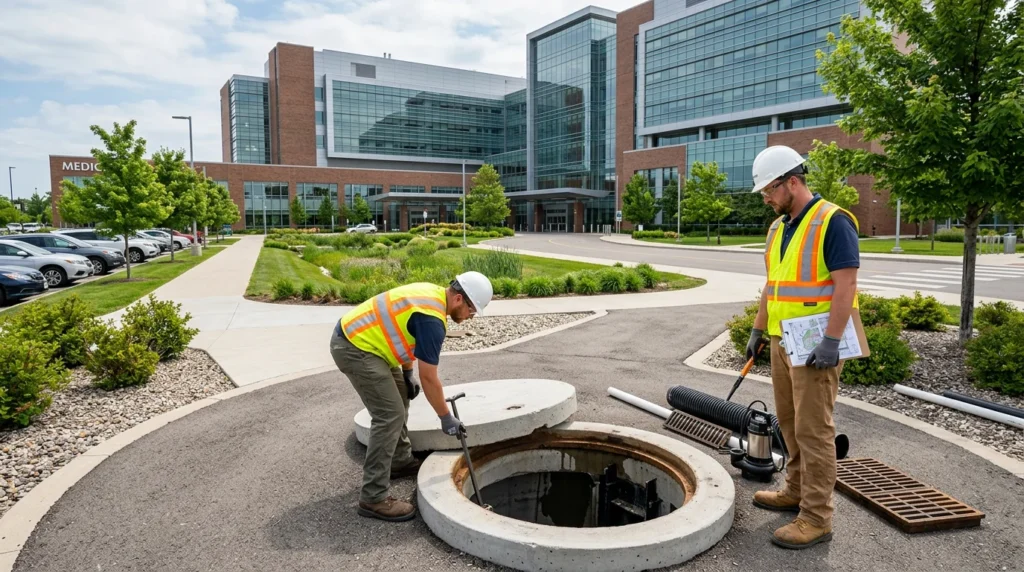
Quick answer: A stormwater management company evaluates how rain and snowmelt move across a site and designs ways to drain, store, or infiltrate runoff to reduce flooding, erosion, and water-quality impacts. Services commonly include field observations, runoff calculations, grading and drainage plans, and coordination with local review agencies. Requirements and permit submittals vary by municipality and state, so the scope is typically tailored to local rules and site constraints.
What They Actually Handle Day to Day
A stormwater management company looks at how water moves across your roof, driveway, yard, parking lot, and nearby streets, then designs a system that sends it where it can go safely. That can mean keeping water on-site to soak in, slowing it down so it doesn’t scour soil, or routing it to an approved discharge point without backing up onto neighboring properties.
Typical work includes site visits to spot low areas and choke points, reviewing soil and slopes, mapping existing inlets and pipes, and preparing plans for grading, catch basins, culverts, swales, infiltration trenches, rain gardens, permeable pavement, or detention/retention basins. They often produce drawings and calculations that local engineering, stormwater, or conservation reviewers may request for approvals, and they can respond to plan-review comments so revisions are targeted instead of guesswork.
For homeowners, the focus is often nuisance flooding, soggy lawns, basement seepage, or washouts. For commercial sites and subdivisions, the focus commonly expands to meeting local stormwater standards, protecting downstream resources, and coordinating drainage with utilities, roads, and landscaping.
Problems That Signal You Need One
Recurring puddles that last more than a day after rain, water flowing toward the foundation, and erosion channels in the yard are common early warnings. In paved areas, look for water sheeting across sidewalks, ponding at low corners of parking lots, or icy patches that show where water is collecting and refreezing.
In more serious cases, you might see sinkholes or sudden depressions (possible pipe failure), sediment washing onto the street, or a swale that has turned into a gully. If your sump pump runs constantly after storms, or your downspouts discharge right next to the house, a drainage plan can often reduce the load on the foundation and lower the risk of water intrusion.
Typical Deliverables You Can Ask For
Scopes vary, but many projects follow a similar set of deliverables. A clear proposal should spell out what’s included and what’s not.
Assessment: site walk/field notes, review of existing plans if available, identification of contributing drainage areas, and a summary of likely causes.
Concept options: 1–3 feasible approaches (for example, regrading vs. infiltration vs. added conveyance), with practical pros/cons and any apparent constraints like high groundwater or tight setbacks.
Final design/permitting: grading and drainage plan, runoff calculations, details for inlets/pipes/trenches/basins, erosion and sediment control notes, and permit or approval exhibits as required by the municipality or state.
Construction-phase support: contractor Q&A, submittal/shop drawing review if applicable, periodic site visits, and a record/as-built plan if changes occur in the field.
Limits and When to Involve Other Specialists
Stormwater design often overlaps with other disciplines, and bringing in the right specialist early can prevent redesign. A land surveyor is commonly needed when exact property lines, easements, spot grades, or drainage rights are unclear, especially near neighbors or the roadway.
A geotechnical engineer or soils testing may be needed for infiltration systems, steep slopes, or sites with questionable fill, because infiltration rates and groundwater depth can make or break the design. If wetlands, streams, or protected buffers might be involved, a wetland scientist and early agency coordination can be necessary, and requirements vary widely by municipality and state. Structural engineers may be needed for retaining walls, headwalls, or any drainage feature tied into a building foundation.
For help scoping a stormwater plan and figuring out which specialists to involve for your site, you can contact Haughawout Engineering & Markets.