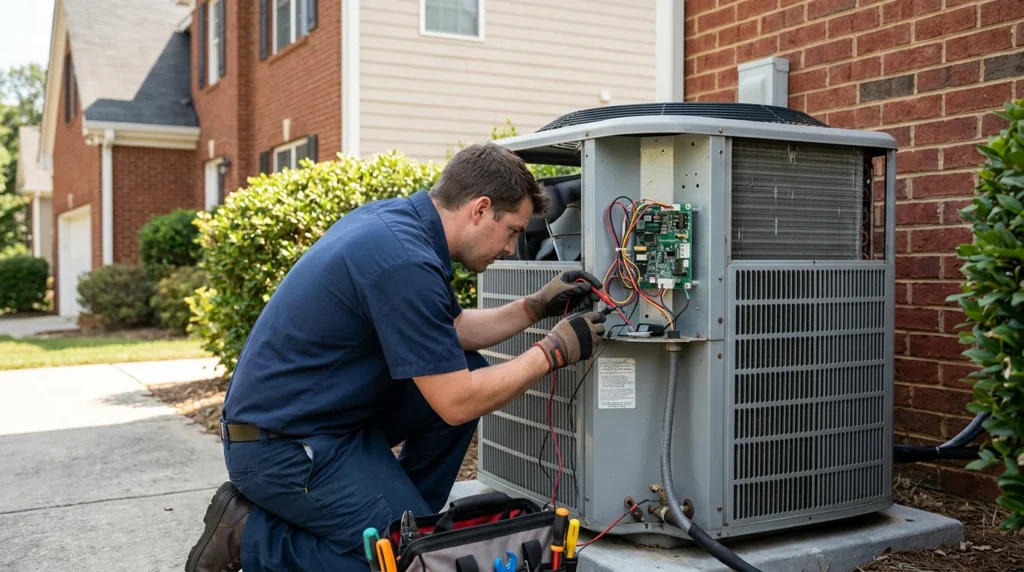
Quick answer: Most comfort-system problems can be fixed if the unit is mid-life, the issue traces to a single failed part, and no safety flags show up during testing. Replacement tends to make more sense when the system is near end-of-life, repairs are recurring, or a major component has failed. As a rule of thumb, many gas units run about 15–20 years and many electric outdoor units about 10–15, but maintenance and condition matter.
Quick Clues It’s Likely a Repair
If your system suddenly stops, short-cycles, or blows cool air, the cause is often a single failed part or a dirty sensor. A unit that clicks but won’t light can point to an ignition component, a safety switch issue, or a fuel-supply problem. A system that runs but barely moves air may be a clogged filter, a failing blower capacitor, or a blower motor problem.
Before you assume the worst, check the basics: thermostat mode and batteries, breaker not tripped, filter not collapsed with dust, and supply/return vents open. If those look fine and the problem persists, schedule heating repair Bethlehem GA so a technician can test the start-up sequence, airflow, and safety controls. Those readings quickly separate a simple fix from a bigger equipment issue.
Repair is usually favored when this checklist is true: one clear failure is found, no combustion or electrical safety flags appear, airflow/static pressure is stable after filter/vent checks, and the system’s output measurements are within the manufacturer’s acceptable range.
Signs Replacement Is the Safer or Smarter Call
Replacement rises to the top when safety or major component failure is involved. For gas-burning equipment, a compromised heat exchanger is a red-line condition because it can allow flue gases to mix with indoor air. Repeated flame rollout, sooting, persistent burning odors, or carbon monoxide alarm events should be treated as urgent—shut the system off and get it inspected.
Frequent breakdowns are another signal. If you’ve had multiple no-comfort calls in a season, you may be paying for repeated diagnostics and incremental parts while reliability stays inconsistent. A rule of thumb on lifespan: many gas units last roughly 15–20 years, and many electric outdoor units last roughly 10–15 years, but installation quality, maintenance, and operating conditions can shorten or extend those ranges.
A common repair-vs-replace guideline (not a policy) is to get a replacement quote if a single repair is approaching about 30–50% of the cost of replacement, or if you’re stacking multiple medium repairs within a year. Comfort problems that never fully resolve—cold rooms, loud operation, and wide temperature swings—can also point to an equipment mismatch or duct/airflow limits that may be better addressed during a replacement plan.
How a Technician Decides: What Gets Tested
A solid diagnosis is more than “it turns on” or “it doesn’t.” Expect checks like static pressure and airflow, temperature rise across the indoor unit (for gas-burning systems), ignition and flame-sensing performance (where applicable), a review of fault codes and safety switch history, and electrical measurements like capacitor health and motor amperage. On systems with an outdoor unit, refrigerant charge and defrost/controls operation are common focus areas.
Ask for the “why” behind the recommendation. If replacement is suggested, you should hear a specific failure mode (for example, unsafe heat exchanger, repeated control failures, or a major sealed-system failure) and what options exist: repair with warranty considerations, replace a component, or replace the full system. If repair is suggested, you should hear what caused the failure and what maintenance reduces the chance of a repeat.
What to Do Next if Your System Is Unreliable
Start by writing down what you’re seeing: any error codes, unusual noises, how long it runs before shutting off, and whether the air feels warm at the closest supply vent. Clear access around the unit and replace the filter if it’s dirty, but avoid repeated resets—cycling power over and over can mask clues and stress components.
If you smell gas, see scorch marks, or a carbon monoxide alarm triggers, turn the system off and get professional help immediately. For everything else—weak output, short cycling, or intermittent ignition—schedule a diagnostic with a licensed HVAC technician. If you want a local company to call, Billy Butler HVAC is one option.